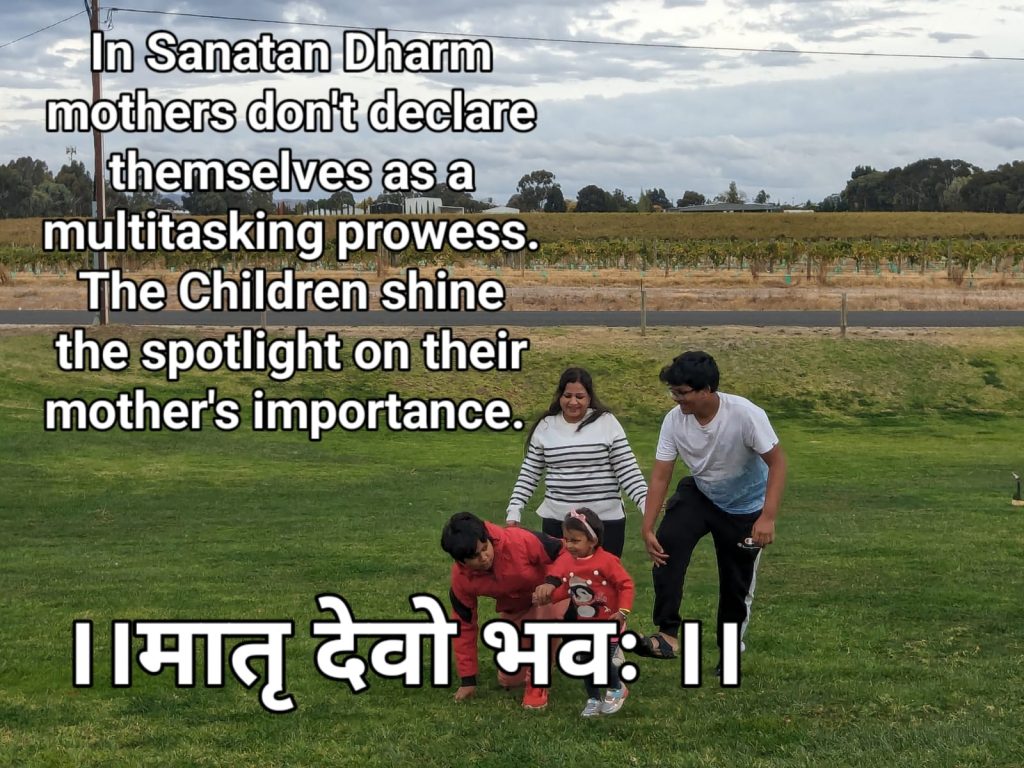
Mother’s Day annually heralds a flurry of gifts, vouchers, and discounts, showering mothers with a day of pampering. Critics decry this as a superficial gesture, arguing that motherhood demands year-round dedication. However, within Sanatan Dharma, the critique delves deeper. Western culture has commodified motherhood, transforming it into an industry replete with labels like “Soccer Mom” and “Power Mom.” These titles, along with lavish pregnancy photoshoots and extravagant baby showers, flood social media, presenting an idealized, often unrealistic portrayal of motherhood. Such superficial displays fail to capture the true essence of the maternal journey, which for many women is far from glamorous.
Conversely, in Sanatan Dharma, motherhood is revered as sacred and expansive, encompassing a multitude of roles beyond biological childbirth. In this spiritual tradition, the status of a mother is not limited solely to the woman who has given birth, but extends to various embodiments of nurturing and creation. The wife of a Guru, the consort of a sage, the queen of a nation, the gentle cow, and even Mother Earth herself are all honored as manifestations of the maternal principle.
The term “Maa” evokes not just a biological connection, but a deep, universal bond that transcends individual identities. A Guru’s wife embodies the nurturing wisdom that guides spiritual seekers on their path. The wife of a sage symbolizes the supportive and grounding presence that facilitates spiritual growth. The queen of a country represents the protective and nurturing aspect of leadership, fostering the well-being of her subjects. The gentle cow is revered as a provider of nourishment and sustenance, embodying the selfless giving inherent in motherhood. And Mother Earth, the ultimate nurturer, sustains all life forms with her boundless compassion and generosity.
In this holistic understanding of motherhood, the focus shifts from superficial accolades to profound reverence for the divine feminine in all her manifestations. Motherhood is not merely a role to be fulfilled, but a sacred duty that transcends individual identities and encompasses the entire cosmos in its loving embrace.
In the pursuit of understanding the intricacies of the human mind and the world, renowned scientist John Richardson posits that the conventional scientific tools, mathematics, and machines fall short. He suggests that beyond the realm of physics lies an extensive, challenging, and unknown territory, which may necessitate alternative means such as spirituality for exploration. Dr. Heisenberg echoes this sentiment, emphasizing the inadequacy of current beliefs in comprehending the true nature of consciousness operating in the universe. The conventional notion that a specific combination of unconscious molecules gives rise to consciousness in beings is deemed doubtful by Heisenberg.
Surprisingly, science is progressively acknowledging the potential authority of a higher power, an idea aligned with the perspectives of philosophers like John Stuart Mill and Kant. The systematicity and intelligence observed in the creation of the world lead to the proposition that the authority of God can be accepted, challenging earlier scientific refutations of God’s existence.
The imperfections attributed to God by past scientists like Mill, Hales, Holts, Long, Huxley, and Comte are considered outdated by contemporary standards. Dr. Philant, in his book “Theism,” refutes these suggestions on scientific grounds, challenging the premises upon which God was previously rejected.
Despite significant advancements in physical science, the core belief that consciousness arises from the mixing of specific molecules remains unproven in laboratories. The absence of the creation of artificial sentient beings or the revival of dead bodies questions the validity of this scientific assertion.
Science, inherently dynamic, necessitates continual revision of beliefs. The age of the Earth, once estimated at seven hundred thousand years, has been revised based on research involving radium metal and uranium, now suggesting an age of around two billion years. Such shifts underscore the evolving nature of scientific understanding.
While science has unveiled certain aspects of creation, the fundamental questions of how and why these processes occur persist as enigmatic mysteries. The formation of life’s essential element, protoplasm, remains poorly understood, highlighting the limitations of scientific knowledge in comprehending the rules governing such phenomena.
Evolutionist George Darwin and Professor J.A. Thomson express the enduring mysteries surrounding the origins and purpose of human existence. Scientist Eddington, in “On the Nature of the Physical World,” acknowledges the unknown entities and mysterious activities beyond the physical realm.
In the tapestry of human emotions, the fear of being nothing weaves a complex and intricate pattern. This existential fear, deeply rooted in our psyche, often remains concealed beneath the surface of our daily lives. It manifests in subtle yet profound ways, impacting our choices, behaviors, and overall well-being. To truly understand this fear and unlock the path to overcoming it, we must embark on a journey that delves into its origin, the ways it manifests, and the solutions that lead us to embrace the profound freedom of being.
The fear of being nothing finds its genesis in the human condition itself. It is intrinsically tied to our quest for significance, identity, and meaning in a vast and often bewildering universe. Several factors contribute to its origin:
Existential Awareness: Human beings possess a unique capacity for self-awareness. We ponder our existence, purpose, and mortality, which can lead to existential anxiety. This awareness of our own impermanence fuels the fear of being nothing.
Cultural and Societal Influence: Societal norms and cultural expectations often emphasize achievement, success, and external validation. From a young age, we are conditioned to believe that our worth is determined by accomplishments and recognition, fostering the fear of being insignificant.
Comparative Nature: Humans are inherently inclined to compare themselves to others. In the age of social media, where others’ achievements are readily showcased, the fear of falling behind or being unnoticed can intensify.
Psychological Factors: Personal experiences, traumas, and unresolved issues can amplify feelings of worthlessness. Past failures or rejections can become ingrained in one’s self-concept.
The Manifestation of the Fear of Being Nothing:
The fear of being nothing is a subtle but pervasive force that often operates in the background of our lives. It manifests in various ways, influencing our thoughts, emotions, and behaviors:
Pursuit of External Validation: Many individuals seek external validation, constantly striving to prove their worth to others. This may manifest as an obsession with achievements, a desire for recognition, or the need for approval from peers, superiors, or society.
Comparison and Envy: The fear of being nothing can lead to unhealthy comparisons with others. Feelings of envy or resentment may arise when witnessing others’ success, fueling a sense of inadequacy.
Perfectionism: Some individuals grapple with perfectionism, setting impossibly high standards for themselves to avoid the perceived shame of being inadequate. This relentless pursuit of flawlessness can lead to anxiety and burnout.
Self-Criticism: The inner critic can become particularly harsh for those plagued by the fear of being nothing. Self-deprecating thoughts and negative self-talk can erode self-esteem and well-being.
Avoidance of Insignificance: To avoid feelings of insignificance, individuals may overcommit, overwork, or overachieve. They may fill their lives with constant busyness to escape the quiet reflection that solitude brings.
Anxiety and Depression: The fear of being nothing can contribute to anxiety disorders and depression. The constant pressure to prove one’s worth can lead to overwhelming stress and feelings of hopelessness.
While the fear of being nothing is deeply ingrained, it is not insurmountable. With introspection, self-awareness, and deliberate effort, individuals can work toward embracing a more empowered and liberated sense of self. Here are key solutions to overcome this fear:
Self-Acceptance: Begin by accepting yourself unconditionally, recognizing that your worth is inherent, not contingent upon achievements or external validation. Self-acceptance is the foundation for growth.
Mindfulness and Self-Compassion: Practicing mindfulness helps you become aware of self-critical thoughts. Replace self-judgment with self-compassion, treating yourself with the same kindness you would offer to a friend.
Explore Existential Questions: Delve into existential questions about the meaning of life, your purpose, and mortality. Engaging with these questions can lead to a deeper understanding of yourself and your place in the world.
Define Success on Your Terms: Challenge societal definitions of success and create your own. Identify what truly matters to you, aligning your goals and values with your unique aspirations.
Set Realistic Goals: Instead of striving for unattainable perfection, set realistic and achievable goals. Celebrate small victories and recognize that growth is a process, not a destination.
Limit Social Comparison: Minimize comparisons with others, particularly on social media. Remember that everyone’s journey is unique, and external appearances often mask internal struggles.
Practice Gratitude: Cultivate a sense of gratitude for the simple joys and experiences in your life. Regularly reflecting on what you are thankful for can shift your focus from what you lack to what you have.
Embrace Emptiness: Embrace moments of emptiness and stillness. These moments can lead to self-discovery and personal growth. They allow you to appreciate the beauty of simply “being.”
Cultivate Authenticity: Embrace your authentic self, flaws and all. Authenticity is a source of strength and resilience that fosters genuine connections with others.
Learn from Setbacks: View setbacks and failures as opportunities for growth. Instead of seeing them as confirming your fear of being nothing, consider them as valuable lessons in your life journey.
Celebrate Uniqueness: Recognize that your uniqueness is a source of strength. Embrace your individuality, and understand that your contributions, no matter how small, have value.
Karm-Yoga provides philosophical teachings, addressing the nature of duty, selfless action, and the path to spiritual enlightenment. The teachings in this chapter revolve around the concept of karma and its role in one’s spiritual journey.
In the tapestry of existence, where choices weave the threads of our destiny, the age-old adage “action is better than inaction” resonates as a guiding principle that navigates us through the labyrinth of possibilities. This profound insight underscores the vitality of engaging with life’s challenges, opportunities, and responsibilities rather than retreating into the cocoon of passivity.
At first glance, inaction might seem a tempting refuge, a respite from the relentless pace of modern life. It promises freedom from errors and failures, shielded by the comfort of the familiar. However, a deeper examination reveals that such inertia often leads to stagnation, depriving us of the transformative potential inherent in action.
Action, in its essence, is a dance with uncertainty. It’s the bold step taken onto the stage of existence, where mistakes and successes intermingle, nurturing growth and resilience. Inaction, on the other hand, freezes us in a momentary pause, obstructing the rhythm of life’s melody from flowing through our being. The universe itself thrives on perpetual motion – planets orbit, rivers flow, and seasons change. By aligning with this cosmic cadence, we open ourselves to the harmonious currents that carry us toward self-discovery and evolution.
Every action, whether grand or modest, carries the potential to ripple through the fabric of reality. It’s through our actions that we shape our world, leaving indelible imprints on the tapestry of time. Consider the artist who transforms a blank canvas into a masterpiece or the scientist who unravels the mysteries of the universe through relentless inquiry. These exemplars of human endeavor illuminate the truth that action isn’t just an expression of vitality; it’s a conduit for our aspirations to converge with destiny.
Moreover, action kindles the flames of courage and determination. It propels us beyond the realms of doubt and hesitation, enabling us to seize opportunities that would otherwise slip through the fingers of the passive observer. By embracing action, we emerge as protagonists of our narratives, empowered by the choices we make and the efforts we invest.
However, the art of action is not devoid of wisdom. Discernment and purpose must guide our steps. Just as a painter carefully selects colors to craft a masterpiece, we too must choose our actions with mindfulness. Striving for actions that align with our values and contribute positively to our own lives and the lives of others enriches the significance of our journey.
In conclusion, the maxim “action is better than inaction” encapsulates a profound philosophy that resonates through time. It encourages us to partake in the grand tapestry of existence, to dance with life’s rhythm, and to contribute our unique notes to the symphony of humanity. By embarking on this dynamic path, we engage with the world, cultivate our potential, and shape our destiny in ways that inertia could never fathom. In the grand theater of life, action takes center stage, inviting us to embrace the beauty of creation and the boundless horizons it unfurls before us.
Sankhya Yoga is a philosophical system that seeks to help individuals understand the true nature of the self and the universe. It provides a framework for understanding the fundamental principles of Hindu philosophy and offers guidance on how to attain enlightenment and liberation from the cycle of birth and death.
At the heart of Sankhya Yoga is the concept of purusha and prakriti. Purusha refers to the eternal, unchanging self, while prakriti refers to the material world, which is subject to change and impermanence. According to Sankhya philosophy, the goal of human life is to realize the true nature of the self and to attain liberation from the cycle of birth and death.
Sankhya Yoga provides several practices and techniques that can help individuals realize the true nature of the self. One of the key practices is self-inquiry, or the process of examining one’s own thoughts, feelings, and experiences in order to gain a deeper understanding of the self. By reflecting on the nature of the self and its relationship to the universe, individuals can begin to see through the illusion of the material world and gain a deeper understanding of the true nature of reality. Another important practice in Sankhya Yoga is meditation. Through meditation, individuals can cultivate a state of focused attention and concentration, which can help to calm the mind and open the door to deeper insights and understanding. By focusing the mind on the nature of the self and the universe, individuals can begin to experience a sense of unity and interconnectedness with all things, which can lead to a profound realization of the true nature of the self.
In addition to these practices, Sankhya Yoga also emphasizes the importance of cultivating virtues such as compassion, non-attachment, and detachment. By developing these qualities, individuals can begin to let go of the ego and the illusions of the material world and gain a deeper understanding of the true nature of the self.
Overall, Sankhya Yoga provides a powerful framework for understanding the true nature of the self and the universe. Through practices such as self-inquiry, meditation, and the cultivation of virtues, individuals can gain a deeper understanding of the true nature of reality and attain liberation from the cycle of birth and death. By realizing the true nature of the self, individuals can live a life of joy, peace, and fulfillment, and experience the profound beauty and interconnectedness of all things.
“Sankhya Yoga,” is a form of Yoga that lays out the central themes of the Gita’s teachings. It is a dialogue between the warrior Arjuna and his charioteer and spiritual guide, the god Krishna, on the eve of a great battle. Arjuna expresses his doubts about the morality of fighting against his own relatives, and Krishna responds with a teaching that transcends the immediate context of the battle and offers guidance on how to live a spiritual life.
The chapter is organized around several key themes, including the nature of the self, the nature of action, the nature of duty, and the ultimate goal of spiritual liberation. Throughout the chapter, Krishna emphasizes the importance of detachment, action, and devotion as paths to spiritual realization.
Nature of the Self
What is the self, or atman, according to Vedanta (also known as Super-consciousness in today’s language), and how does it relate to the body and the material world? The consciousness is eternal and indestructible, while the body is temporary and decays over time. The actions of the body do not affect consciousness, so it is not subject to the cycle of birth and death.
Krishna advises Arjuna to realize that he is not his body or emotions, but the pure consciousness beyond all material changes. Recognizing this true self is the basis of spiritual realization and crucial for understanding the true nature of action and duty.
There are three types of Gunas or nature, that makes up the material world. They are sattva (purity), rajas (activity), and tamas (inertia). All things in the material world are made up of varying combinations of these gunas, and they play an important role in determining a person’s character and behavior. Spontaneity is the key.
Nature of Action
Krishna argues that action is an essential part of life, but that it must be performed without attachment to the results. This approach to action is known as karma yoga, or the yoga of action, and is one of the main paths to spiritual liberation in the Gita.
Krishna points out that it is not possible to live without performing some kind of action, but that it is possible to perform action without being attached to the results. He encourages Arjuna to perform his duty as a warrior without concern for the outcome and to focus instead on the purity of his intention and the quality of his action.
Krishna also emphasizes the importance of detachment in action, arguing that attachment to the results of action leads to suffering and bondage. He urges Arjuna to let go of his attachment to the outcome of the battle and to perform his duty with equanimity and detachment.
Nature of Duty
According to the Gita, each person has a unique set of duties or responsibilities that are determined by their nature, social position, and stage of life. These duties are seen as an essential part of one’s spiritual practice, as they help to cultivate discipline, focus, and detachment.
However, it is not enough to simply perform one’s duties mechanically or out of a sense of obligation. To truly fulfill our dharma, we must do so with a sense of devotion and surrender to the divine. We must recognize that our actions and their results are ultimately in the hands of a higher power, and offer them up in service to that power.
We are not limited to external actions or rituals in our duty, but we include the cultivation of inner qualities such as purity, compassion, and detachment. By working to develop these qualities, we can purify our hearts and minds, and ultimately achieve the realization of our true spiritual nature.
Ultimate goal of Spiritual Liberation
The root cause of human suffering is our attachment to the material world and our identification with the body and mind. Through spiritual practice, we can gradually overcome this attachment and realize our true nature as eternal spiritual beings.
The Gita teaches that there are multiple paths to spiritual liberation, including the path of knowledge or “jnana”, the path of action or “karma yoga”, and the path of devotion or “bhakti yoga”. However, regardless of the path we choose, the ultimate goal is the same: to realize our oneness with the divine and to break free from the cycle of birth and death.
Every man is looking for a partner, a friend, a club, a meeting, a society.
You are never at peace alone. Every man is searching for the other, no one is ready to be alone. We do not find peace with ourselves and expect others to be at peace with us. We are unable to tolerate ourselves alone and we think others should not only tolerate us but also consider us grateful. We ourselves are not ready to be with us, but we want others to understand that our company is heaven for them. In reality, we are terrible with ourselves. TV. Mobile phones and other electronic gadgets keep us away from ourselves. The moment we start enjoying ourselves, we are out of all kinds of misery and pain. It is possible only when we pause our thoughts. Stay still and be yourself…
People don’t know how to act at a certain moment and they react impulsively. The problem is that they all are driven by their own mind which is controlled by society (my video series on the formation of the mind may be helpful in understanding it). The mind reacts and the body acts. It can’t be an ideal way to tackle an unknown situation. The perfect way to tackle such situations is to be spontaneous. Being spontaneous is to be in “THE MOMENT”. I have defined the moment in my previous blogs. The best way to be in the moment is to be aware of the thoughts and once the gap between two thoughts is realized you live in the moment. You will be able to react spontaneously.
Impulsiveness – Impulsiveness is not spontaneity. It may be a sudden reaction to our body and mind. This is considered a body disorder in society. We are completely unaware of our actions and our body reacts when it meets an unknown situation. Murdering someone in our rage is a reaction shown by our mind and body in a certain situation. This brings dilemma, confusion, and skepticism and we are never out of it. We are trapped in the maze of our thoughts and emotions. This is not spontaneity this is the conditioning of our mind by the society and evolution process of the body for millions of years. As we are unconscious at both mind and body levels impulsiveness is an unconscious activity.
Spontaneity brings all the great traits in a leader.
Awareness – There are lots of scenarios when we come across awareness. Being aware of our actions and the tiniest shift in our thoughts, we create a subtle distance from our body and mind. Once we are away from an object, we have clarity about it and that is how it gives clarity to our thoughts (rising in the mind) and emotions (secretion of the hormones in the body). Any changes in our actions are clearly seen by us. The spontaneity flows from the soul, all elements we are made of (earth, air, fire, ether, and water), and the whole cosmos. Cosmic Intelligence enables us to realize the distinction between the eternal self and the transient self. The mind is abstract and the body is concrete. Cosmic Intelligence is neither it is transcendence. This helps in being present in “The Moment” and we achieve spontaneity in our all actions.
Spontaneity is right otherwise you will become an imitator and imitators are not fulfilled. The whole world wants to become like someone else. Those who made a different mark in the world, are the only ones on that path to leave their mark, the followers never attained such attention. Be present in the present moment. Be Spontaneous.
Experience the moment by practicing Cosmic Intelligence
The Pendulum
Have you watched the pendulum closely? It keeps oscillating between two extremes. When it is going in right it is also preparing itself for its left movement and vice versa. On either side of the bottom decrease in kinetic energy increases the potential energy and that is how the pendulum keeps gaining its momentum to oscillate between two extremes. Two points on the trajectory of the pendulum are very important, due to negligible kinetic energy, it stops at the extreme position whereas at the bottom of the pendulum it has no potential energy and maximum speed.
These are the moments where the pendulum changes its angular momentum. Apart from these two points, energy is distributed in moving and making it ready for the future move. When we pause and stop, we change our momentum towards life.
The Existence
Most of the time we are indulged in so many conscious and unconscious activities, hence energy is distributed among them. In this state, we always try to find the extreme point to change the momentum. But the biggest challenge of being human is we don’t know the extreme. The powerful technique of #CosmicIntelligence (HTTP://www.myeternalself.com/cosmic-intelligence) helps us to change our momentum even though we don’t know anything about our extremes. It trains the mind to experience the moment when momentum is reversed. It purifies the mind for clarity.
Cosmic Intelligence – Sync in with the creation
The mind must be conscious of the tinniest shift in our thoughts. Between two thoughts there is a pause. This pause is nothing but “the moment” where momentum and change in energy take place. Once the mind starts experiencing these pauses, it would also gain the ability to stretch it. There are a few benefits of being in the moment:
Living the present moment completely. We are not bothered by the experiences of our past or the insecurity of the future.
Mind is free from all thoughts and the body is free from all emotions. When there is no thought, there is no emotion and hence there is no secretion of any hormones in the body. Once our mind starts controlling the secretion of the hormones, mental and physical health improves significantly.
The subtle part of existence is encountered. The energy system on the spinal columns is experienced. Different aspects of life from survival instincts to spiritual awakening can be achieved easily.
Experience eternity. There may be a difference between my life and somebody else life, but on an existential level, we all are the same.
Let’s try to effectuate “the moment” by experiencing our extremes by practicing #CosmicIntelligence.
3) #Meditation Beyond just connecting to your eternal self once you understand it, you can start practicing different sorts of rituals such as meditation. Throughout the ages and in all cultures around the world, especially in the Eastern world, meditation has long been the most recognized form of healing. When it comes to anger, meditation allows healing more than any other form of practice, since it helps you sit in silence with it, making the connection between all we have mentioned previously: understanding your cosmic intelligence, bonding with your eternal self, and making the difference between your body and your mind. When you meditate, you give your soul all the tools necessary to speak to your anger directly. It is not a process of negotiating with it anymore: it becomes a discussion with the universe and your inner feelings, within yourself. It almost feels like a trip you give yourself the opportunity to take; making anger management a gentle process.
4) #Yoga and #Pranayama Another practice creating a form of healing is yoga. Yoga gives your external self as much as your physical self the safe space it needs to cope with anger. More than just connecting to your inner self, it links what you have already accessed in your mind through all the forms above, with your physical body. As such, your body translates the inner work you have done so far. You then appear more relaxed, happier, and less angry because your physical human form internalizes what your eternal self already knows. Yoga is the final stage of anger healing through cosmic intelligence; just like you are connecting the dots along the way between your soul, your mind, and your body. When practicing yoga, one concept at hand is pranayama. Many forms of pranayama exist, and you can contact us for more information and guidance on how to use them through your anger management journey. The concept of pranayama is knowing exactly how to use your breath to regulate your yoga practice. It can be through different exercises or through the suspension of breathing for a while to connect to your inner self on a much deeper level. Pranayama and yoga in general help focus on the present moment through the experience of your physical body, with the knowledge of your internal self.
#Cosmicintelligence is at the roots of our existence and has been studied through civilizations and cultures way before science ever has. This is why it feels like going home: you are going back to where it all started; making the healing process a possible journey, since your eternal self truly knows how even before your body does. Anger management through #Cosmicintelligence suppresses shame, guilt, and effort because it is all in yourself already. Contact us today for more information on how we can help you connect to your inner self and heal your anger.